

Why Your Thyroid Cares So Much About Stress — and How We Actually Address It
If you’ve been told you have a thyroid issue, chances are the word, “stress” has come up somewhere along the way.
Maybe you were told:
“Stress can affect your thyroid.”
“Your symptoms are probably stress-related.”
Or simply, “You need to manage stress better.”
And yet… no one ever explained how stress affects the thyroid, why it matters, or what can actually be done about it.
That’s where the conversation often falls short.
At The Wellness Way – Lake Forest, we don’t look at the thyroid as a standalone gland. We look at it as part of a communication system in the body— one that is deeply influenced by the nervous system and the adrenal glands, which regulate how your body responds to stress.
One way I often explain this is by using a farming analogy. Think of the thyroid as the corn in the field, and the nervous system and adrenal glands as the farmers. The farmers don’t become the corn — but they strongly influence how well it grows.
When the land is supported, nourished, and cared for, the corn has what it needs to grow well. When the land is under stress — depleted, overworked, or poorly supported — growth suffers, even if the corn itself isn’t defective.
The same is true in the body. When stress signals are balanced and well-regulated, thyroid communication tends to be clearer. When stress becomes chronic or overwhelming, the body adapts — and thyroid function often reflects that adaptation.
Why Stress and the Thyroid Are Always Connected
Your thyroid doesn’t decide how hard to work on its own.
It responds to signals that it receives from the brain (as we discussed in Blog 1), the nervous system, and the stress hormones produced by the adrenal glands. When the body perceives stress — whether physical, chemical, or emotional — the thyroid shifts into a protective state⁴.
In that protective state, the body stops asking “How do I thrive?”
and starts asking “How do I survive?”
When survival becomes the priority, systems like digestion, hormone balance, and energy regulation take the backseat and often adapt in order to compensate— and the thyroid is especially sensitive to that shift⁵.
This helps explain why so many people tell me:
“My thyroid symptoms started after a really stressful season.”
“Everything changed after burnout, pregnancy, or a major life event.”
“I’ve never felt quite the same since.”
That’s not a coincidence.
That’s physiology.
Stress Is Not a Feeling — It’s a Body State
One of the most important shifts I help patients make is understanding that stress is not just something you feel — it’s something your body experiences.
Your nervous system is constantly scanning your environment and asking:
“Am I safe right now?”
If the answer is no — or even uncertain — the body will react by shifting into protection mode. That shift influences:
- Hormone signaling
- Energy output
- Immune activity
- Thyroid communication
From a chiropractic perspective, this matters deeply because the nervous system is the master regulator. The nervous system connects your brain to all of the organs, glands, and nerves throughout your body. When the nervous system is overloaded, the body adapts — and those adaptations often show up as fatigue, anxiety, hormonal changes, or thyroid symptoms.⁷
Most people are familiar with the concept of “fight or flight.” When the body perceives a threat, it shifts into survival mode. In that state, functions like digestion, hormone balance, and long-term regulation are deprioritized — not because they aren’t important, but because survival comes first.
The same principle applies here. When the nervous system stays in a prolonged state of stress, the body adapts its priorities — and the thyroid often reflects that shift.
This isn’t your body failing.
It’s your body doing exactly what it was designed to do under stress. Adapt to survive.
Where the Adrenal Glands Fit Into Thyroid Health
Your adrenal glands work closely with the nervous system to manage stress hormones like cortisol.
In short bursts, cortisol can be incredibly effective. Cortisol helps you wake up, respond to challenges, and adapt to your environment.
But when stress (cortisol) becomes chronic (too high for too long)— from poor sleep, emotional overload, inflammation, blood sugar swings, constant pressure — the body adapts this as its “new normal”. Your adrenal glands can struggle to know when to “turn off”. So, cortisol patterns can shift, energy regulation changes, and thyroid signaling may be affected⁹.
This is why people often describe feeling:
“Wired but tired”
Overstimulated during the day but exhausted at night
Less resilient to stress than they used to be
Again — this is not a weakness.
It’s an adaptation.
How Stress Shows Up in the Body — and How We Actually Address It
This is where I want to be very clear about how we approach thyroid and stress concerns at The Wellness Way.
We don’t stop at saying “it’s just stress.”
And we definitely don’t just guess.
We test.
Because stress physiology, adrenal patterns, and thyroid communication leave measurable clues in the body — such as patterns seen in hormone testing, nutrient levels, inflammatory markers, and how the body responds over time. And we don’t want to miss those.
We Don’t Guess — We Test
Using Blood Work to Guide the Conversation
When someone is struggling with thyroid symptoms and stress-related patterns, we don’t start with assumptions — we start with information.
That’s why we often begin with comprehensive blood testing, not just a single lab value. Blood work helps us gather clues that guide the same core questions we’ve been talking about throughout this series (especially in blog 2!) — questions like whether the body has what it needs to make thyroid hormone, whether hormone is being used effectively, whether the immune system is involved, and whether stress is interfering with normal communication. Did you know your bloodwork can help us see that?
Depending on the individual, thyroid bloodwork may include:
- A full thyroid panel (TSH, Free T4, Free T3, Reverse T3, antibodies)
- Vitamin D
- Iron and ferritin
- Inflammatory markers
- Blood sugar markers
The goal of this testing isn’t to label or overwhelm — it’s to bring clarity. Because afterall, you’re looking for answers.
Numbers don’t tell the whole story, but they guide us to ask the follow up questions that make most sense and guide the next steps of action, with intention instead of guesswork.
DUTCH Hormone Testing: Understanding How Your Body Is Handling Stress
Blood work gives us valuable information — but when it comes to stress, it doesn’t always tell the whole story. Which is why comprehensive testing is key. We need what’s called the DUTCH test, too.
Why? Stress hormones don’t just matter in the moment they’re measured. They matter in how they’re produced, how long they stay elevated, and how the body breaks them down over time⁸.
This is where DUTCH hormone testing becomes incredibly helpful.
The DUTCH test measures cortisol (from the adrenal glands that sit above your kidney) and other hormones through urine, allowing us to see patterns across the day — not just a single snapshot¹².
It’s entirely possible for someone to have “normal” cortisol levels in blood, yet still feel exhausted, wired, anxious, or burned out. But again, we are looking for the “why”.
Blood testing shows what cortisol looks like at one moment in time — and that moment can be influenced by adrenaline, anticipation, or even the stress of the blood draw itself.
Urine testing shows us something different:
- How much cortisol your body is actually producing
- How your body is metabolizing and breaking it down
- Whether stress hormones are lingering longer than they should
- Whether the stress response is elevated, blunted, or inconsistent throughout the day¹²
In other words, blood testing helps answer:
“Is cortisol present?”
DUTCH testing helps us understand:
“How is your body handling stress overall?”
This distinction matters — especially for thyroid health.
I am going to be vulnerable with you all here. Below is my cortisol portion of the DUTCH and cortisol by blood. And let me tell you, the last two years have been quite stressful– I moved back from Ireland, I started a business, my sister got married, my dad hurt his arm and I ran two businesses. I am not going to lie, I knew I was handling a lot of stress, but I was in a “I’ve got this!” mentality and I truly thought I was adapting.
My bloods show my cortisol within a “normal” range. My DUTCH shows my cortisol through the absolute roof:

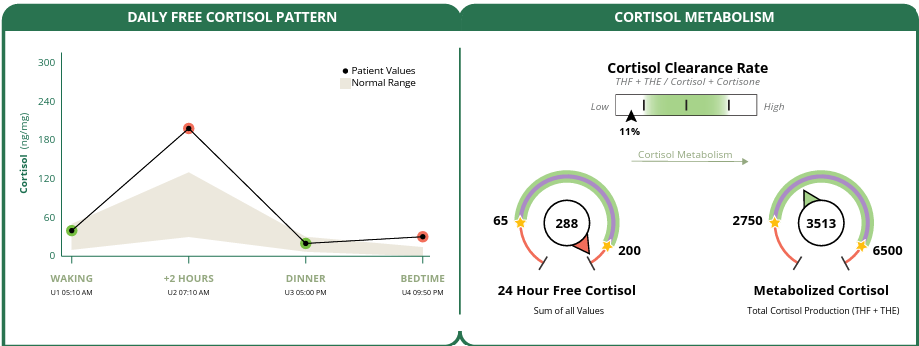
I was clearly not adapting– I cut back on hours, social media, writing blogs (sorry!) and had to make me a priority to heal.
Why Two People With “Normal Labs” Can Feel Completely Different
One of the most common — and frustrating — things I hear is:
“I’ve been told my labs are normal, but I don’t feel normal.”
And here’s the truth: two people can have labs within the same reference range and experience their bodies very differently.
Every body is different. Literally. Your stress and life is different from everyone else’s.
Reference ranges for “normal” don’t account for: timing, patterns, stress load, nervous system regulation, or how the body is adapting day to day. One person may be resilient and regulated, while another is operating in survival mode — even if their numbers look similar on paper.
This is why we focus so much on patterns instead of isolated values. When we look at how hormones are produced, how they’re broken down, and how the nervous system is responding, the picture often becomes much clearer. Testing doesn’t tell us everything — but it helps us move from “everything looks fine” to “this finally makes sense.”
Why Stress Patterns Matter for the Thyroid
The thyroid is highly sensitive to stress signals.
When cortisol patterns are off — even subtly — the body may shift into a more protective mode. This can influence:
- Thyroid hormone signaling
- Energy production
- Sleep quality
- Overall resilience
This doesn’t mean something is broken.
It means the body has been adapting.
And adaptation leaves clues — if you know where to look.
Supporting the Body’s Ability to Adapt
Testing gives us clarity.
What we do with that clarity is what makes the difference.
At The Wellness Way, we focus on supporting the body’s ability to adapt to stress, rather than forcing it into balance.
That support often includes:
Chiropractic Care (Nervous System Support)
As a chiropractor, my primary focus is supporting nervous system communication. When neurological stress is reduced, the body often has a greater capacity to regulate hormones, handle stress, and move out of constant survival mode⁷,¹³.
Lifestyle & Sleep
Sleep, circadian rhythm, and daily routines play a powerful role in stress hormones and thyroid signaling.
Nutrition & Blood Sugar Balance
Blood sugar instability is a major stressor on the nervous system and adrenal glands and can influence stress hormone output.
Targeted Supplement Support
Based on testing, we may recommend specific nutrients or supports to help regulate stress responses and support resilience — never one-size-fits-all.
Thoughts & Emotional Stress
Emotional load matters, not because it’s “mental,” but because it has real physiological effects on the nervous system.
Where Stress Goes Next
Stress doesn’t stay in the nervous system.
Over time, the signals created by chronic stress are processed through the gut and the liver — the very systems responsible for hormone conversion, detoxification, and immune balance⁵.
This is why stress often shows up later as:
- Digestive changes
- Food sensitivities
- Inflammatory patterns (including weight issues!)
- Difficulty converting thyroid hormone effectively
It Still Starts With a Conversation
If stress has ever been mentioned to you without explanation — or if your thyroid story has never quite made sense — I want you to know this:
There is a way to understand what your body is doing.
There are ways to test it.
And there is a path forward.
At The Wellness Way – Lake Forest, it starts with listening, testing, and guiding — not guessing.
Have questions about stress, thyroid patterns, or testing?
📧 Email us — I’m always happy to talk.
It starts with a conversation. And I’m all ears.
Disclaimer: This content is for educational purposes only. It’s not intended as a substitute for the advice provided by your Wellness Way clinic or personal physician, especially if currently taking prescription or over-the-counter medications. Pregnant women, in particular, should seek the advice of a physician before trying any herb or supplement listed on this website. Always speak with your individual clinic before adding any medication, herb, or nutritional supplement to your health protocol. Information and statements regarding dietary supplements have not been evaluated by the FDA and are not intended to diagnose, treat, cure, or prevent any disease.

